Saturday, December 14, 2019

Dec 9 - 15

Revelation 1-11

It is revelation, not revelations.

1st thoughts. Revelation is hard to understand. Full of peculiar symbols. Can I get past that mindset?

This is what the manual says.

Ultimately, you don’t have to understand every symbol in Revelation to understand its important themes, including its most prominent theme: Jesus Christ and His followers will triumph over the kingdoms of men and of Satan.

Thats reassuring. Because at the start of the week I decided I'm not even going to try and understand everything. That would have been too much.

Even if you don't understand all of the symbolism, what sort of imagery is coming through? What is happening? Do we get the impression there is some kind of battle, a fight? Good against evil. Serpents & Dragons might usually be associated with evil. Lambs & children associated with good.

I do wonder why such obscure imagery was used. I think the answer is found in the 1st line of the manual. It asks the following. Have you ever struggled to express to others what you felt during a powerful spiritual experience? Everyday language can feel inadequate to describe spiritual feelings and impressions. I did get the impression that the symbols we being used, less to be literal comparisons, but more to provoke emotions and feelings.

What general thoughts or themes came through for you?

When will this battle start? Has it started already?

Consider making a list of all the images.

Rev 1
The number 7
7 Golden candlesticks - 7 churches
7 Stars - the angels of the 7 churches
Two edged sword out of his mouth

Rev 2
Rod of Iron
Vessels of a potter broken into shivers

Rev 3
Dragon with seven heads
Crowns on those heads

-----------------------------------------------------------------------------------------------------------------------

Questions from the manual this week

-Have you ever struggled to express to others what you felt during a powerful spiritual experience?
-Why might he have compared Church congregations to candlesticks, Satan to a dragon, and Jesus Christ to a lamb?
-How can I make sense of the book of Revelation?
-Who was John?
-How is the book organized, and what are some themes to look for?
-What do the symbols in Revelation represent?
-What truths do I learn from Revelation about what Heavenly Father has done to help me return to Him?
-How can this help me understand God’s plan for me?
-What does Jesus Christ promise to those who overcome?
-What changes do you feel prompted to make to overcome your challenges?
-Why could Jesus Christ alone do this?
-How can you show your faith in Him as your Savior?
-What are you inspired to do to better prepare yourself and your family for the Second Coming?
-What would he say is going well?
-How might you improve?
-Why does Jesus knock instead of just coming inside?
-How can we invite His influence into our home?
-What can these verses teach us about why we wear white for temple ordinances?

I'd like to focus on the highlighted questions.

-----------------------------------------------------------------------------------------------------------------------

Have you ever struggled to express to others what you felt during a powerful spiritual experience?

Answered above

-----------------------------------------------------------------------------------------------------------------------

How can I make sense of the book of Revelation?

See next three questions

Did anybody have a go at looking into these questions?

-----------------------------------------------------------------------------------------------------------------------

Who was John?


Who wrote Revelation? John. Which John? John the beloved. Which one was John the Beloved (we learned a while ago, John was, even back then, a common name)?

Manual points us to 1 Nephi 14:18-27 & the Bible Dictionary 'John'.

The footnote of 1 Nephi refers to him as the apostle John. Sounds like he was given the keys to write about the end of the world.

Bible dictionary is clear from the get go, 'one of the twelve'. It also states that he is the disciple that has been allowed to remain on the earth as a ministering servant until the time of the lords second coming.

Emphasis placed on the word ministering.

-----------------------------------------------------------------------------------------------------------------------

How is the book organized, and what are some themes to look for?

The manual states Ultimately, you don’t have to understand every symbol in Revelation to understand its important themes, including its most prominent theme: Jesus Christ and His followers will triumph over the kingdoms of men and of Satan.

The Bible Dictionary says The message of Revelation is the same as that of all scripture: there will be an eventual triumph on this earth of good over the devil

Also, confirming my thoughts as before By a little study, the theme can be perceived even if the details are not completely identified.

I loved this, also from the Bible dictionary, It may be in this sense that the Prophet Joseph Smith said that Revelation was “one of the plainest books God ever caused to be written” (HC 5:342). However, the more fully the details are understood, the greater will be the appreciation of the theme. If we fail to catch a glimpse of the theme, we fail in our comprehension, no matter how many details we are able to understand. Basically saying, if you focus too much on the symbolism, and miss the overall theme then you have wasted your time. So if you did get that good triumphing over evil vibe, you have understood the book of revelation. Well done.

Did anyone else find anything interesting in the Bible dictionary they wish to share?

-----------------------------------------------------------------------------------------------------------------------


What do the symbols in Revelation represent?

I could list the symbols as found in D&C 77. However, simply listing the meanings of the symbols is only half the job. They mean nothing until we read the verses again where the symbolism is found.

For example out of context the sea of glass is the earth in its sanctified, immortal & sanctified state and the four beast are the glory of the classes of beings in their destined sphere of creation.


Now we need to go back to Revelation 4:6 and reread the verse with the substitution to see if we gain any greater insight.


And before the throne there was the sanctified earth: and in the midst of the throne, and round about the throne, were the glory of the classes of beings in their destined sphere of creation full of light & knowledge before and behind.

hmm. Not sure it is fantastically clearer. Probably then need to read the other verses of revelation to fully appreciate the symbolism.

I wonder if anyone has reworked the book of revelation of all the approved (lds) symbolic substitutions. If I had time, I might have had a go, or even looked online. My journey of literal symbolic substitution came to end, with simply reading what the ensign has to say, where I came across the repeated message.

to read the text of the book of Revelation as a sort of intricate puzzle that must be solved risks going beyond the mark and missing the vision’s central message.


-----------------------------------------------------------------------------------------------------------------------

Why does Jesus knock instead of just coming inside? & How can we invite His influence into our home?

Rev 3:20 - This is a good example of how maybe Revelation is not as hard to understand as we think it is.

Behold, I stand at the door, and knock: if any man hear my voice, and open the door, I will come into him, and will sup with him, and he with me.
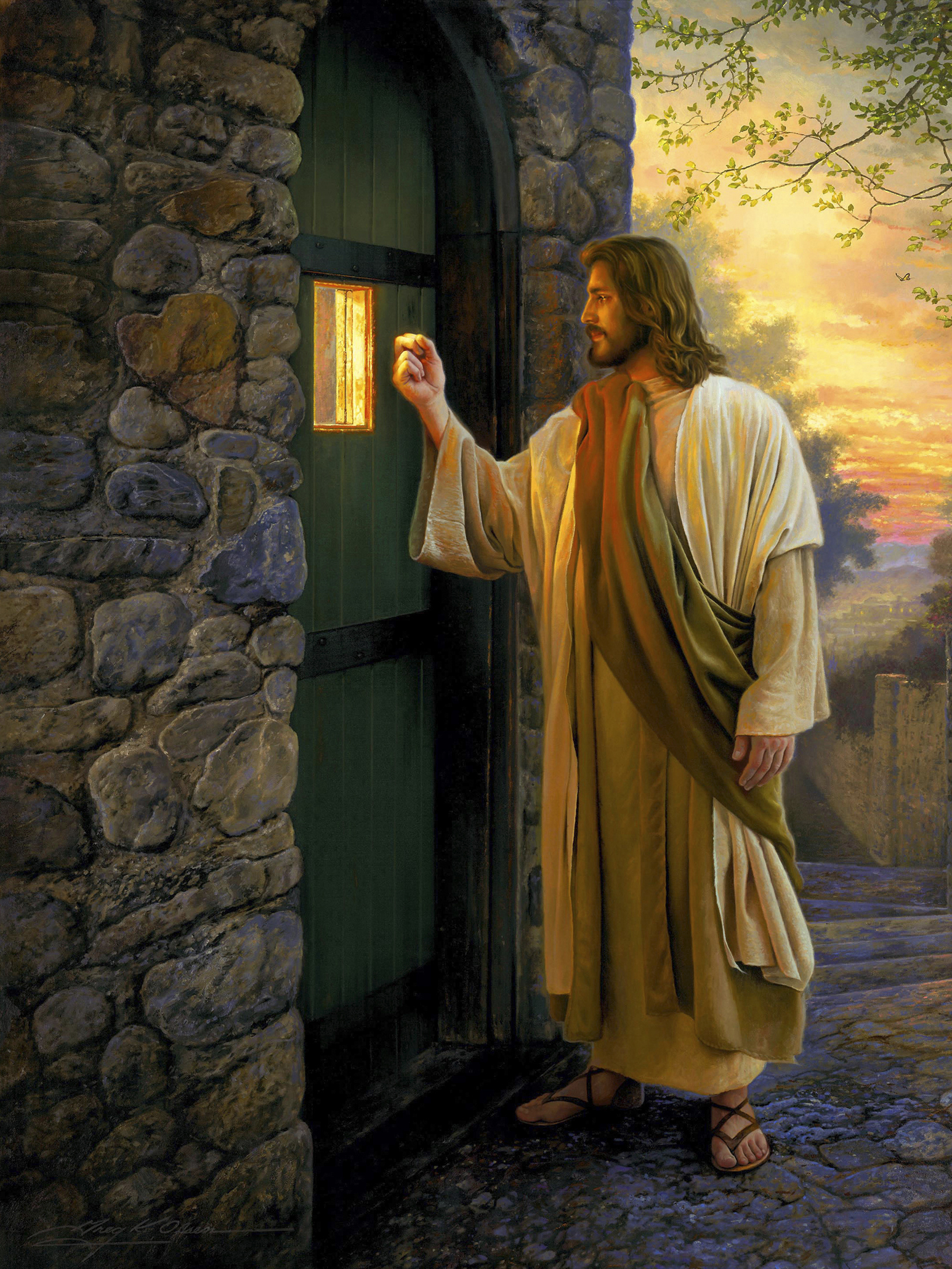


There is some pretty simple imagery here.

We could have a go at dissecting this one and answering the questions the manual pose.

My 1st thoughts
-What door is he talking about here? The door to ones heart?
-Why is he knocking at my door? Because he want's to talk to me.
-What is his message? Good news, come follow me, the welfare of my soul. Peace, Love, Charity.

Why does Jesus knock instead of just coming inside?
Because it is rude to just barge into someone else home. May be treated as uninvited and rejected. Forcing ones ideas upon another is not the way. That is someone else's way. There is no growth in forcing someone to do something. Knocking is akin to inviting, not forcing.

He will not just sup with us, but we with him. Two way communication, he listens, we listen.

How can we invite His influence into our home?
We need to listen for the knock. We need to listen for his invitation & be sensitive to the spirit. He does not literally knock on doors. So what is knocking on the door a metaphor for? How does he get our attention? Moments like this? Church, temple, personal & family study, prayer.

I don't know if it is wise to leave the door wide open so he can just come in. Unless one has a filter.

Here is a fun little insight. If this verse was written today, it may not use the metaphor of the door, but possibly refer to instead a notification on your phone. Imagine, he's trying to sent you notifications all the time, but you keep looking at your phone. You're using the wrong device!

-----------------------------------------------------------------------------------------------------------------------


Thursday, November 14, 2019

Nov 11 - 17

Hebrews 7-13

Topics

Hebrews 7 - Melchizedek Priesthood - Symbolism of Jesus Christ

Hebrews 8 - Symbolism of Jesus Christ

Hebrews 9 - Holy of holies, testament (footnotes substitutes 'covenant'), Symbolism of Jesus Christ

Hebrews 10 - Symbolism of Jesus Christ continued, second coming.

Hebrews 11 - Faith

Hebrews 12 -

Hebrews 13 - Chastenings

Famous/Popular verses

Hebrews 11:1 Now faith is the substance of things hoped for, the evidenceof things not seen.

Hebrews

Thoughts

Hebrews 7:24-28 Jesus never made sacrifices at the alter but made a sacrifice of himself, his life in every way.

Hebrews 7:27 After watching the video and understanding that the symbolism of the lamb is us being layed upon the alter for our own sins (a form of repentance), it makes sense that the saviour will not have needed to do this. He had no sin to offer up a sacrifice for. Therefore he was the lamb. I am struggling to put into words the concept here.

Hebrews 8: 1-3 In chapter 7 I get the impression that Christ is compared to an order even above the Melchizedek Priesthood (Hebrews 7:21-22). While the people were practicing the law of Moses the priests often made offerings on behalf of the people. If therefore Christ is the most high priest, then he should have something to offer. Which indeed we know to be his own life which then puts 7:23 into perspective. There was only one great priest, who did suffer to continue by reason of death.

Hebrews 8:7-13 Explaining that the new covenant is better than the old with greater mercies granted.

Hebrews 9:13-14 If the blood of random animals had some power over the people to cleanse them, how much more has the blood of the saviour.

Hebrews 9:22 Shedding of blood. What happens when something sheds its blood? It dies, or becomes weaker. What blood are we metaphorically killing when we apply the atonement? If our sins be personified, we are killing our sins and laying them on the alter.

Hebrews 9:26 "hath he appeared to put away sin by the sacrifice of himself". Or in my words, Christ accepts the slaughter and offering of our sins.

Hebrews 10:10 we are sanctified through the offering of the body of Jesus Christ. Imagine, instead of burnt offerings weekly as described in the videos, the saviour on the alter each week. He is on the alter instead of us. We should be on that alter, the Lamb represents us, and the Lamb represents the Saviour. You have maybe heard before, how the trays under the linen look like a body. We ofter suggest it is the saviours, comparable to how he was left in the tomb. But he was a substitute for us. So in reality, would it be more profound to suggest it is our body on the alter?

Hebrews 10:37-39 Who's on the lords side? When he comes you need to be ready to join him. Hold back at all and he will no have you.

Hebrews 12:6 After I have convinced you to have more faith I will remind you that whom the Lord liveth he chasteneth.

Hebrews 12:11 Trials are pants. However after the trial it yieldeth the peaceable fruit of righteousness.

Hebrews 12:17 Remember Esau. A little lapse, and despite seeking repentance carefully through tears, it was too late.

Hebrews 13:5 Just good advice. Be grateful for what you have. You will always have enough, God will not leave you.

Hebrews 13:11-12 More symbolism. Initial suffering within the walls, then taken outside to be finished off.

------------------------------------------------------------------------------------------------------------------------

This year, I have found that there is no substitute for reading the scriptures. You can listen, you will get something from it, but reading takes scripture study to a whole new level.

When I 1st listened to the verses on Monday morning I have to confess I didn't get chapters 7-10. I understood that chapter 7 had something to do with the Melchizedek priesthood and the following verses had something to do with symbolism of the saviour. There were multiple references to a testament, that I didn't understand and then there were references to faith which I felt I could relate to a lot better. I was sure when I returned to the content, I would end up focusing on Chapter 11 & faith because chapters 7-10 seemed so abstract.

As it turns out my study took a U-turn once I learned that the JST replaces the word testament with the word covenant & once I watched the two videos.

What experiences did you have?

List the topics we have found in the chapters this week.

I'd like to spend some time on chapters 7-10 is you would let me. Mainly because I feel there are some greater rewards to be gained from these chapters. Faith is not a new concept, we have had many lessons on faith over the years. Not so much about our covenants.

To understand this weeks chapters I feel it necessary to go back one week to understand who the epistle of Hebrews was written for. What faith did the hebrews practice? This is what the manual says

We all have to give up something in order to accept the gospel of Jesus Christ—whether that be bad habits, incorrect beliefs, unwholesome associations, or something else. For Gentiles, conversion often meant abandoning false gods. For the Hebrews (Jews), however, conversion proved to be, if not more difficult, a little more complicated. After all, their cherished beliefs and traditions were rooted in the worship of the true God and the teachings of His prophets, extending back thousands of years. Yet the Apostles taught that the law of Moses had been fulfilled in Jesus Christ and that a higher law was now the standard for believers. Would accepting Christianity mean that the Hebrews must give up their earlier beliefs and history? The Epistle to the Hebrews sought to help settle such questions by teaching that the law of Moses, the prophets, and the ordinances are all important, but Jesus Christ is greater . In fact, all these things point to and testify of Christ as the Son of God and the promised Messiah the Jews had been waiting for. The message for the Hebrews, and for all of us, is that sometimes we must give up traditions to make Jesus Christ the center of our worship and our lives—for it is through Christ “that we may obtain mercy”

For the Jews, it might have been like a new prophet coming along and saying the way we have been worshiping to date, has been preparing for a new form of worship, and that we are now to change the way we doing things. We may may have been doing something a certain way for as long as we can remember, or before. Our parents or even grand parents had done it this way. Now a new prophet comes along and tells us we need to do it differently now. How well will that go down?!!!!

Any modern day examples?

-2 hour church. Also known as? Home centred learning.
-Home Teaching / Ministering
-Youth Organisation / Mutual
- Witnessing at baptisms & 11 year olds being advanced to youth.
-Animal Sacrifices

Find out how many people watched the videos. Consider playing them.

'The Tabernacle' focuses on the hardware. 'Sacrifice & Sacrament' focuses on what goes on in the tabernacle.

The Tabernacle

Draw a map of the tabernacle. Label it up. Ask the class to ponder the the symbolism and compare with the symbolism in the covenants we make today. Consider writing down what you notice to share after.

-The courtyard celestial world. Coming to the saviour.
-Alter, sacrifices are made. The perfect animal symbolic of the ultimate sacrifice of the saviour. Faithful members made an offering that represented their sins.
-Fires of the alter of incense symbolic of the holy spirit.
-Laver of water. Priests washed before entering the holy place or terrestrial world.
-Holy place, the terrestrial world, living by the spirit.
-Candlestick/Menorah, provided light or illumination from the holy ghost.
-Bread & water/wine reminder of his sacrifice. Like real bread, it nourishes us.
-Incense, symbol of prayer. Location of this prayer, at the alter directly in front of the veil preparing to enter his presence. Today prayer are said before entering.
-Cherubim, angels of God.
-Lid of the Ark, mercy seat.
-Holy of Holies, celestial kingdom. In todays temples we pass from room to room, world to world.
-Main entrance faces east.

Many outsiders may look at what we do in the temple as strange, but upon closer inspection, it really is not too dissimilar to the ancient Israelites temple.

Sacrifice & Sacrament

Do you ever wonder how the law of sacrifice prepared the ancient people of Israel to look forward to Christ?

What would your answer be?

Why might this question be relevant given the context of who the hebrews were?

What is your personal offering when you partake of the sacrament?

------------------------------------------------------------------------------------------------------------------------

If we have time

Hebrews 11 & Faith

Some questions from the manual.

If someone asked you to define faith, what would you say?

What do the examples of the people mentioned in this chapter teach you about faith?

-v4. Abel offered a more excellent sacrifice
-v5. Enoch was translated
-v7. Noah prepared an ark
-v8. Abraham followed the direction of the lord
-v9. Abraham sojourned in the land of promise
-v11. Sariah conceived
-v17. Abraham offering Isaac.
-v20. Isaac blessed Jacob.
-v21. Jacob blessed the sons of Joseph.
-v22. Joseph prophesied.
-v23. Moses Parents hid him.
-v24. Moses chose not to be identified as an Egyptian.
-v27. Moses lead Israel out of Egypt.
-v28. Moses kept the passover.
-v28. The Israelites passed through the red sea.
-v30. The walls of Jericho fell.
-v31. Rahab perished not.
-v32-34. Gedeon, Barak, Samson, Japhthae, David, Samuel.

What is faith?

How do we develop faith?

In what ways are we blessed when we exercise faith?

What happens when we choose not to exercise faith?

What will you do to strengthen your faith?


Saturday, November 2, 2019

Oct 28 - Nov 3

As the year concludes, you may wish to review how you have done as we have adopted come follow me. As an individual and as a family.

For me my study has been lees about my behaviour but more about what I can share that will help the class.

Though I can confidently say I have completed the Bible this year. I can't remember the last time I did that. Maybe seminary. If that is the minimum you too have achieved, I still think that is worth a pat on the back.

For me, I have discovered things in the new testament I did no know. I understand it's construction a lot better, who wrote the texts and who they were for. There have been long Saturday nights, staying up until 2 or 3am to ensure I have read and understood sufficiently & considered plenty of questions to ask and prepared answers if needed.

For those of you who have managed to do more than just read (or maybe listen), but also study and discuss in your household I applaud you and am confident your lives are richer for it.

Would anybody else like to share their thoughts on this years study? I may ask again in a few weeks.

Looking forward to next year can anyone tell me what we are studying? I'll give you a clue, it is not the Book of Mormon.

It is The Book of Mormon: Another Testament of Jesus Christ.

The church is releasing some new videos. They are available on the gospel library app.

Anybody had a sneak peek yet?

--------------------------------------------------------------------------------------------------------------------------------------

This week.

Lots of little chapters with lots of tid bits.

Lots of verses you may have heard regularly over the years but not necessarily associated with these books.

For example...

nubian
a;boinarb
o;inafb

1st. Lets discuss who Timothy & Titus were and why these next epistles are slightly different to the other epistles. Timothy & Titus had served with Paul on some of his missionary journeys. They were then called as leaders of Congregations, sounds like a...Bishop. This is all in the manual.

I have a couple of directions we can go in this week.

I've been liking the format I've been using of late, where we list topics on the board of things we found in the assigned chapters.

But I carve a few other direction we could go in?

1. Topics
2. Popular Verses
3. List good example and bad example behaviours listed in these chapters
4. Discuss what caught your eye this week and what you learned

Any preference?

--------------------------------------------------------------------------------------------------------------------------------------

1. Topics

What topics were covered in this weeks reading?

1 Tim 1 : Hope & Faith in Jesus Christ
1 Tim 2 : Pray for leaders, views towards women
1 Tim 3 : Bishops & Deacons,
1 Tim 4 : Apostasy
1 Tim 5 : Policy regarding widows
1 Tim 6 : Money
2 Tim 1 : Fear & Shame
2 Tim 2 :
2 Tim 3 : Apostasy & Scriptures
2 Tim 4 : Apostasy & Teaching
Titus 1 : Bishops qualities & Duties
Titus 2 : Behavioural do's and don'ts
Titus 3 : Behavioural do's and don'ts
Phil 1 :

--------------------------------------------------------------------------------------------------------------------------------------

2. Popular Verses

1 Tim 4:12 : Let no man despise thy youth; but be thou an example of the believers, in word, in conversation, in charity, in spirit, in faith, in purity. See section 3.

1 Tim 6:10 : For the love of money is the root of all evil: which while some coveted after, they have erred from the faith, and pierced themselves through with many sorrows. 

2 Tim 1:7 : For God hath not given us the spirit of fear; but of power, and of love, and of a sound mind.

2 Tim 1:8 : Be not thou therefore ashamed of the testimony of our Lord, nor of me his prisoner: but be thou partaker of the afflictions of the gospel according to the power of God;

2 Tim 3:1-5 : This know also, that in the last days perilous times shall come.
2 For men shall be lovers of their own selves, covetous, boasters, proud, blasphemers, disobedient to parents, unthankful, unholy,
3 Without natural affection, trucebreakers, false accusers, incontinent, fierce, despisers of those that are good,
4 Traitors, heady, highminded, lovers of pleasures more than lovers of God;
5 Having a form of godliness, but denying the power thereof: from such turn away.

2 Tim 3:7 : Ever learning, and never able to come to the knowledge of the truth.

2 Tim 3 16-17 : All scripture is given by inspiration of God, and is profitable for doctrine, for reproof, for correction, for instruction in righteousness:
17 That the man of God may be perfect, throughly furnished unto all good works.

2 Tim 4:7 : I have fought a good fight, I have finished my course, I have kept the faith:


--------------------------------------------------------------------------------------------------------------------------------------

3. Good Example & Bad Example

Good Example
Grace, Mercy 1 Tim 1:2
Charity 1 Tim 1:5
Faith, Charity, Holiness, Sobriety 1 Tim 2:15
Blameless, Husband of 1 Wife, Vigilant, Sober, Hospitable 1 Tim 3:2
Patient 1 Tim 3:3
Good report 1 Tim 3:7
Honourable, Dignified 1 Tim 3:8
Labour & Suffer 1 Tim 4:10
Meditate (study) & apply 1 Tim 4:15
Righteousness, Faith, Charity, Peace 2 Tim 2:22
Gentle to all, Patient 2 Tim 2:24
Blameless, lover of hospitality, Sober, Just, Holy, Temperate (Self Control) Titus 1:7-8


Bad Example
Blasphemy, persecutor, voilent 1 Tim 1:13
Given to wine, bullying, greedy of lucre (money), brawler, covetous 1 Tim 3:3
Deceitful 1 Tim 3:9
Lies & Hypocrisy 1 Tim 4:2
Vain babbling 2 Tim 2:16
Flee youthful lusts 2 Tim 2:22
Foolish & unlearned questions 2 Tim 2:23
Lover of self, Covetous, Boasing, Pride, Blasphemous, Disobedience to parents, Unthankful, Liars, Fans Accusers, No Self Control, Traitors, heady (Rash), high-minded (puffed up, conceited),  2 Tim 3:2-4
Self Willed (Obstinate, Arrogant), Angry, Given to Wine Titus 1:7-8


As per the title of this weeks lesson how can we be an example...
in word?
in conversation?
in charity?
in spirit?
in faith?
in purity?

--------------------------------------------------------------------------------------------------------------------------------------

4. What I Enjoyed

A couple of mine were the following

Tim 1:11-17 Paul admits he used to persecute the saints. He calls himself a chief sinner for it. But even such sins have been forgiven. Should we then follow the saviours example and forgive those that offend us? How bad do we have to be before we cannot be redeemed?

I've tried to work out if Paul was physically a prisoner when he was writing this as he calls himself a prisoner a lot (2 Tim 1:8, Phil 1:1,9). If not, it seems like an unusual thing to say. After listening to a podcast on this is was suggested he was using the term kind of like the word criminal. He has been imprisoned for the cause of teaching the gospel. He has been a prisoner. The gospel of Jesus Christ was introducing new ideas that many people were struggling to understand and as a result of their misunderstanding some people in authority believed they were menaces and locked up those teaching these new doctrines. Same happened to Joseph smith and many of the missionaries in the Book of Mormon.

Christ mission was not to save sinners but repentant sinners.

Regardless of your political views you may have noticed the verse suggesting we give thanks for leadership. Maybe we could pray for our MP’s to gain some clarity and unity! 1 Tim 2:1-3

1 Tim 3:4-5 Such an obvious principle. The family is the fundamental unit of society. If more men looked after their family and managed this, then he will likely be more qualified to serve in the church. After all, our end goal is to manage a rather large family.

1 Tim 5:8 Explaining the need to provide for your family.

1 Tim 5:20 Not sure how I feel about this one. In most instances resolutions between man and the saviour and kept behind the bishops door in the name of confidentiality.

1 Tim 5:25 Our actions will define who we are, not what we will say we will do.

1 Tim 6:7 I noted the intentional use of the word Certain.

1 Tim 6:17 What are 'uncertain riches'? Basically anything physical. Yes, money, but some people rely on stuff to make them happy. If this is the case, and this stuff cannot come with you, then you will be unhappy when you pass through. You can only rely on one thing. not just for happiness but salvation too.

2 Tim 2:10-12 There are many verses like this in this weeks reading. Basically giving a promise of eternal life through Jesus Christ. These verses also remind me of the beatitudes. The meek shall inherit the earth.

There were many verses relating to focusing on the Saviour rather than on thing of no to little value, whether that be gossiping, back biting, or just asking questions that there is no answer for or challenging beliefs with science 1 Tim 6:20

2 Tim 3:6 For of this sort are they which creep into houses. Have we been warned of late of anything creeping into our homes?

2 Tim 3:15 Paul shows us the value of the scriptures and we can see what type of people come from reading the scriptures from a young age. Another comparison with Joseph Smith who was reading the bible avidly at 14 and younger.

2 Tim 4:1-5 Comparing what I'm reading with the world, 'heap to themselves teachers' or put in place people supposedly learned to tell us what is right and what is wrong. For example identify as whatever you want to be.

2 Tim 4:16-18 : At my first answer no man stood with me, but all men forsook me: I pray God that it may not be laid to their charge.
17 Notwithstanding the Lord stood with me, and strengthened me; that by me the preaching might be fully known, and that all the Gentiles might hear: and I was delivered out of the mouth of the lion.
18 And the Lord shall deliver me from every evil work, and will preserve me unto his heavenly kingdom: to whom be glory for ever and ever. When Paul started his ministry he felt alone in terms of mortal aid. However the lord was with him & he was delivered.


Friday, September 13, 2019

Sept 9-15

2 Corrinthians 1-7

Some verses that caught my eye

Chapter 1

3 Blessed be God, even the Father of our Lord Jesus Christ, the Father of mercies, and the God of all comfort;
4 Who comforteth us in all our tribulation, that we may be able to comfort them which are in any trouble, by the comfort wherewith we ourselves are comforted of God.

Chapter 2

7 So that contrariwise ye ought rather to forgive him, and comfort him, lest perhaps such a one should be swallowed up with overmuch sorrow.
8 Wherefore I beseech you that ye would confirm your love toward him.
9 For to this end also did I write, that I might know the proof of you, whether ye be obedient in all things.
10 To whom ye forgive any thing, I forgive also: for if I forgave any thing, to whom I forgave it, for your sakes forgave I it in the person of Christ;
11 Lest Satan should get an advantage of us: for we are not ignorant of his devices.

Chapter 3

3 Forasmuch as ye are manifestly declared to be the epistle of Christ ministered by us, written not with ink, but with the Spirit of the living God; not in tables of stone, but in fleshy tables of the heart.
6 Who also hath made us able ministers of the new testament; not of the letter, but of the spirit: for the letter killeth, but the spirit giveth life.

Chapter 4

16 For which cause we faint not; but though our outward man perish, yet the inward man is renewed day by day.
17 For our light affliction, which is but for a moment, worketh for us a far more exceeding and eternal weight of glory;
18 While we look not at the things which are seen, but at the things which are not seen: for the things which are seen are temporal; but the things which are not seen are eternal.

Chapter 5

10 For we must all appear before the judgment seat of Christ; that every one may receive the things done in his body, according to that he hath done, whether it be good or bad.

18 And all things are of God, who hath reconciled us to himself by Jesus Christ, and hath given to us the ministry of reconciliation;

Chapter 6

Chapter 7

9 Now I rejoice, not that ye were made sorry, but that ye sorrowed to repentance: for ye were made sorry after a godly manner, that ye might receive damage by us in nothing.
10 For godly sorrow worketh repentance to salvation not to be repented of: but the sorrow of the world worketh death.

13 Therefore we were comforted in your comfort: yea, and exceedingly the more joyed we for the joy of Titus, because his spirit was refreshed by you all.

-----------------------------------------------------------------------------------------------------------------------

Before I start.

Announcements from Relief Society or Priesthood

When I 1st listened to these chapters I had no idea what Paul was saying. The only word that meant anything to me was reconciliation.

Before I go into a few things I have planned I want to do the same again and identify the themes (or topics) that Paul was referring to in these chapters.

I found the following

Forgiveness
Restitution
Trials

I also found this quote from Jeffery R Holland

"Be kind regarding human frailty—your own as well as that of those who serve with you in a Church led by volunteer, mortal men and women. Except in the case of His only perfect Begotten Son, imperfect people are all God has ever had to work with”

Did this quote catch your eye? If so, why? What did you conclude from your ponderings?

To me it serves as a reminder that I work with imperfect people. So stop getting frustrated. But if you dig a little deeper and think it through you realise that this includes yourself.

Also, how does this fit in with this weeks reading? Understanding this may add further insight.

------------------------------------------------------------------------------------------------------------------

[Read] 2 Corinthians 2:5-11 - I Receive Blessings and Bless others when I Forgive

What's happened here? The manual refers to the possibility of a man transgressing and the saints rejecting him...rather than rejecting his sin. Paul is having to remind the saints we need to be more forgiving. Kind of similar to what we were just talking about.

I want to discuss the questions from the manual.

Why do we sometimes fail to “confirm [our] love toward” someone who has offended us? (verse 8).

How does withholding forgiveness harm others and ourselves? (see verses 7, 10–11).

What does it mean to you that withholding forgiveness from others gives “Satan … an advantage of us”?

Personally, I have really struggled with this this week. I don't delight in saying this, but as a teacher of the principles & doctrine of the church and even Christ's gospel, I am not always the perfect example of what I teach. I would be confident that many of us, when we teach the gospel may feel hypocritical to one degree or another. We know what the doctrine is, we know what we should do, but we have our vices, our weaknesses, that prevent us from being perfect. This week I have struggled with forgiveness.

How many times a day do you hear the word sorry? Probably more than you realise. Someone might bump into you in the corridor or on public transport. We acknowledge it, but it is immediately forgotten because you have immediately forgiven them.

But every now and again someone does something that really hurts you. It may have been completely accidental, but you don't care, you have been wronged. You are entitled to be hurt.

This is a completely hypothetical situation. Imagine you have spent your life feeling like everything has been a struggle, and suddenly things start to look positive. Your finances now have a bit of breathing space, so you splash out and buy yourself something you dreamed of as a kid. This thing is special to you. Now imagine if someone comes along and breaks it. They break it a lot. Rendering it unfit for whatever its purpose is and for more than three weeks do nothing about it, leaving you with the responsibility of fixing it. How would you feel? Remember, this is completely hypothetical!

Let's discuss some possible answers or thoughts to the previously mentioned questions.

Q: Why do we sometimes fail to “confirm [our] love toward” someone who has offended us? (verse 8).
A: Because we have been hurt by them, and fear being hurt by them again.
A: Because we believe the law of Moses (or justice) will serve us better, more than the law of mercy. An eye for an eye, a tooth for a tooth. So we feel justly dealt with.
A: Because we think failing to forgive someone in some way gives us power over them, like we are holding them ransom.

Q: How does withholding forgiveness harm others and ourselves? (see verses 7, 10–11).
A: President Monson, Hidden Wedges, 2002.
A: In order to be forgiven, we must be willing to forgive. Matt 6:15 But if ye forgive not men their trespasses, neither will your Father forgive your trespasses. Luke 6: 37 Judge not, and ye shall not be judged: condemn not, and ye shall not be condemned: forgive, and ye shall be forgiven:
A: Forgiveness can be one of those things where the following is true. The longer you leave it, the harder it gets.

Q: What does it mean to you that withholding forgiveness from others gives “Satan … an advantage of us”?
A: I'm reminded of the word enmity as I ponder this. A state of active opposition. This is how wars start. He will use those feelings to make us do some pretty stupid things. How many stupid things have been said or done, when a person has been in an altered state of mind driven by feelings of enmity?

Q: Therefore what? What can we do to be more forgiving?
A: From the teachers manual. Elder Kevin R. Duncan taught: “One key to forgiving others is to try to see them as God sees them. At times, God may part the curtain and bless us with the gift to see into the heart, soul, and spirit of another person who has offended us. This insight may even lead to an overwhelming love for that person” The difficult might be not wanting to see them as God sees them.
A: 2 Cor 2:9
A: Other examples include Luke 15:11-32 (Prodigal Son) & John 8:1-11 (Woman caught in Adultery).

----------------------------------------------------------------------------------------------------------------------

[Read] 2 Corinthians 1:3–7; 4:6–10, 17–18; 7:4–7 - My Trials can be a Blessing

I have to admit the language in these verses is difficult.

Did any of these verses stand out to you or you feel like you got something from them?

I picked out 1:3-4; 4:16-18

In our family we recently experienced another trial. Like we haven't got enough already. Erica had something up with her eye. We took her to the walk in in Trafford, the GP and then to the Eye Hospital in Manchester. Her eye was so swollen she couldn't open it. It was so purple it was the same colour as her tongue.

After a few visits and after the swelling seemed to have gone, the Dr noticed she has a stigmatism and has prescribed her glasses. She's 2. If she doesn't wear the glasses she could end up with a lazy eye. How fortunate the Dr's discovered this at such a young age. Had Troy not got shingles, which lead to Erica's condition then none of us would have been any the wiser? A blessing in disguise? Possibly.

Anyone else have any examples of blessings that have come from trials?

Slight tangent

This lesson covers trials, It is generally understood that trials are learning experiences which make us more like our father in heaven.

It also covers repentance which purifies us, enabling us to be in the presence of our father in heaven.

It made me think. Say we had little no trials resulting in little to no growth, but relied on repentance only through this like, making us pure. Would this be sufficient to save us?

Say we had loads of trials resulting in phenomenal growth, but used the atonement little or not at all. Would this be sufficient to save us?

Are the two liked?

As I understand it Christs atonement wasn't just about helping us overcome sin, but sorrows and other worldly pains.

----------------------------------------------------------------------------------------------------------------------

There was another great quote from the teachers manual which sat perfectly with last weeks priesthood lesson.

For most, repentance is more a journey than a one-time event. It is not easy. To change is difficult. It requires running into the wind, swimming upstream. Jesus said, ‘If any man will come after me, let him deny himself, and take up his cross, and follow me’ [Matthew 16:24]. Repentance is turning away from some things, such as dishonesty, pride, anger, and impure thoughts, and turning toward other things, such as kindness, unselfishness, patience, and spirituality. It is ‘re-turning’ toward God


Saturday, August 31, 2019

Aug 26 - Sept 1

1 Corinthians 8:13

Chapter 8 - Idolatry
Chapter 9 -
Chapter 10 - Temptation, Sacrament
Chapter 11 - Customs, Sacrament
Chapter 12 - Gifts of the Spirit, unity
Chapter 13 - Charity

--------------------------------------------------------------------------------------------------------------------------

I'm going to start with a reality drop, Rachel & I have had a horrendous last few weeks. All 3 kids are or have been sick to varying levels of severity, Rachel has had extra work to complete, I got a speeding ticket while we were on our washout holiday and then last week someone accidentally damaged some of our property which could leave us substantially out of pocket so have been dealing with insurance companies all week. And thats on top of the already stressful circumstances that we were already in.

You know that feeling, when you feel like you just can't take anymore, and you you are given more, we are definitely feeling it right now.

I hope you all have had a better August than we have.

Anyway...

I spent a moment pondering where we are in the New Testament.

We have a new leader, instructing new members of a new church? Does this sound familiar? I never considered this before but the New Testament (post the 4 gospels) are kinda like the ancient worlds doctrine & covenants). Am I being silly or are you inclined to agree that there are similarities?

This week contains one of my favourite verses. Can you guess which one?

1 Corinthians 10:13

There hath no temptation taken you but such as is common to man: but God is faithful, who will not suffer you to be tempted above that ye are able; but will with the temptation also make a way to escape, that ye may be able to bear it.

If so, how did you guess right?Do I have a sign on my head suggesting I really need a verse about deliverance from temptation and God's faithfulness in my life? Is it a scripture mastery (for those familiar with seminary)? Or is it because you also appreciate it in some way.

The ideas for personal study section has some great questions about this verse which I hope we will look as shortly.

But 1st, I want to try something that I tried a couple of weeks ago. I want to ask you what topics you noticed come up in this weeks reading and what you learned?

Temptation
Talents (Spiritual Gifts)
Unity
Charity
Sacrament
Race

Unity

Somewhere this week I came across the quote that said something like 'being unified is not the same as being the same'.

Give every class member a cutout of some eyes, ask them to put them on the board and create a body with them. 1 Cor 12:17

Ask every class member to think, if they were a body part of the church, what body part would you be? Then list those body parts on the board. Note the use of the word 'member'. We are members of the body of Christ. 1 Cor 12:27.

What do we notice? This might resemble a body a bit more than the previous example. But why is this still not working?

Answers might include
-More humility required
-Listening to the spirit
-Inspired leaders

What would the result be if we applied these principles?

Talents

Maybe I speak for myself here but sometimes we are not very good at seeing the good in ourselves. I've been in many a lesson about talents and found it difficult to identify my own. I see talents in other better.

Elder Marvin J Ashton in 1987 said the following

One of the great tragedies of life, it seems to me, is when a person classifies himself as someone who has no talents or gifts.

https://www.churchofjesuschrist.org/study/general-conference/1987/10/there-are-many-gifts

So I pondered this for a bit and thought of another activity. I don't think I've ever had such an interactive lesson.

I don't need to give you a piece of paper, just use your phone or something. I want everyone to look around the room and write down at least one, preferably about 3, talents you see. Then we list them on the board. I'm not expecting any name dropping, the idea here is to get us thinking about whether any of these shoes fit.

Here is a list Marvin J Ashton

the gift of asking
the gift of listening
the gift of hearing and using a still, small voice
the gift of being able to weep
the gift of avoiding contention
the gift of being agreeable
the gift of avoiding vain repetition
the gift of seeking that which is righteous
the gift of not passing judgment
the gift of looking to God for guidance
the gift of being a disciple
the gift of caring for others
the gift of being able to ponder
the gift of offering prayer
the gift of bearing a mighty testimony
the gift of receiving the Holy Ghost.


Temptation 10:1-13

So if I was reword 10:13 it might read

Temptations are a part of life, we are all subject to them. But God will not allow you to be tempted beyond your ability to resist, therefore making it possible for you to overcome all temptations.

What kind of escape from temptation has heavenly father provided for you?

We all have agency. We might feel like at times agency is diminished, but we will never be forced to do something we should not.

Daniel (old testament) was tempted to compromise his religion by a decree. Expecting maybe to be eaten by Lions, he is unharmed.

Maybe there were times when you could not see the light at the end of the exit tunnel, but you knew this was the right path to take.

Like paying tithing. I've heard many stories of people paying tithing but not knowing to pay some bills.

Or these last few weeks for my family. The light at the end of the tunnel seems awfully dim at times. We can still see many obstacles in our way. but we persevere.

What can we do to help each other “escape” and “bear” the temptations we might face?

How does unity help us resist temptation?

Race 9:24-27

Have any of you taken part in a race? Did you expect to come 1st? To obtain a shiny metallic prize?So why did you do it? To beat a friend, to encourage a friend, to beat yourself? Or maybe for an incorruptible crown?

Charity

I'd get the impression the Relief Society quote this many parts of chapter 13 a fair bit.

1 Cor 13:2 Paul says without Charity he is nothing. Does that mean we too are nothing if we do not have charity? What does he mean by 'I am nothing'?

1 Cor 13:3 Paul says if I give, without charity, it profits him nothing. What does he mean by 'profiteth me nothing'?

Have we ever been guilty of this? What could we give, without charity?

1 Cor 13:13 Why would Paul consider charity greater than faith & hope?

Something to do with Matt 22:37-40.

Faith & Hope only lead you to become a person with Charity. It is the obtaining of charity that will save us. You could say, Charity is the byproduct of faith. Charity is the works of faith. faith without works is dead.


Sunday, August 18, 2019

Aug 12-18

Summary of Chapters

As per usual, what did you learn this week? This is the forum to share. I do want these lessons and discussions to be more than just my musings and some of my personal revelations. I'd love to know what you learned.

My approach to these lessons will be to prepare as much as possible, but I will always feel under prepared, and if Rachel & I have a bad week, I might only get a few hours to put a lesson together. For me, that's not enough. I tell you this, because I need you to know that I need you to help me. I need you to have learned something this week and I need you to be willing to add to the lesson. I need you to be prepared to be active participants in the class. In fact, It's more than just me that needs this from you. It's you. You need you to have learned something this week.

On a personal level, not every week is a good week. Some weeks the amount of study and preparation I've put in is embarrassing, but I try to keep those weeks to a minimum.


The manual points out that the suggestions contained in it are only a small suggestion of the many different directions you cold have taken your study this week. We do not need to be constrained by the content of the come follow me manual.

Let the holy ghost guide you in you journey.

I think there was a lot of good content in this weeks reading. One reason would be because there was actually a lot of chapters available to study.

Some topics mentioned in this weeks reading

The Love of God.
Natural man and vulnerability.
Foreordination.
Judging others.

Romans 7-16

Romans 7

The law of Moses is dead. You are free from that law. The new law and commitment is to the law of Christ. v6 But now we are delivered from the law, that being dead wherein we were held; that we should serve in newness of spirit, and not in the oldness of the letter. Stop living by the letter of the law, there is no spirit in it.

v8. What do you think it means when it says For without the law sin was dead? Did anybody go to the footnotes with this one or was it obvious? Alma 42:17. How could he sin if there was no law? I would also add v21. if there was no law given, if men sinned what could justice do, or mercy either, for they would have no claim upon the creature.

Similar to where I work. One of my responsibilities is to check the drawings of others. Sometimes there are disagreements between the draughtsman and the checker. Many of these disagreements come from personal preference because there are no rules written down about how to represent some information. Due to a lack of rules the draughtsman is neither right or wrong and the checker is neither right or wrong. One of my ongoing tasks is writing a handbook, a set of guidelines for the draughtsman to follow. This then clarifies who's personal preference is correct.

One of the messages I got from this weeks chapters was the idea that you cannot sin if there is no law. But you cannot do any good either.

I wonder if this was what life was like for Adam and Eve. They had two commandments. Anything else they did was neither a form or righteous living or riotous living. How could it be. There were only two rules for them to live by. Do not partake of the fruit of the tree of knowledge of good and evil and to multiply and replenish the earth. No laws about etiquette, manners, greed or jealousy.

v18-19. Reminds me of Mosiah 3:18. This natural man make me do things I don't really want to do.

Maybe we feel like Paul at times who in v25 says In my mind I serve God. But with the flesh I sin.

Romans 8

v16-17 We are the children of God.

Parents. What do you want for your children? What do you want them to have? Everything you have and more? Can you give it to them? What do you want them to be? Can you give it to them? We can give good gifts, like God can. But we and he cannot make us good, that is something we need to learn how to do ourselves.

Refer to Elder Oaks parable from the teachers manual.

Looking for hope? Try these verses on for size. v38-39. Nothing shall be able to separate us from the love of God.

From the manual, Sister Linda S Reeves words.

How did reading or hearing those words make you feel? Did you believe them? Do they change you in any way?

Romans 9

v15-16 I will have mercy on whom I will have mercy, and I will have compassion on whom I will have compassion. He's not saying It doesn't matter if you are good or bad, God randomly picks and chooses who gets in and who does not. Keep reading.

Paul calls himself the apostle of the gentiles. Following the chapters which give insight into the idea of foreordination Paul mention the birthright the descendants of Israel have. Though this birthright does not automatically qualify anyone for entry into Gods kingdom. Imagine if it did. The Israelites would get lazy and complacent, even wicked, if they thought there is nothing they cold do that would prohibit them from glory. In fact, this is what they started doing. Likewise, the Gentiles are not permanently excluded from the glory of God. Both parties need to have faith and obey the commandments.

Romans 10

v12 For there is no difference between the Jew and the Greek: for the same Lord over all is rich unto all that call upon him.

Romans 11

This is where verses about faith and works appear.

v21 For if God spared not the natural branches, take heed lest he also spare not thee. In other words, if God can condemn his chosen people, how much more can he condemn other groups.

v24 how much more shall these, which be the natural branches, be grafted into their own olive tree? Implying that God is merciful, repentance is possible and almost easier for those that previously had. If you leave, and then learn you made a mistake and desire to return, do not despair, you are not beyond his reach.

Romans 12

v1 contains an unusual phrase. present your bodies a living sacrifice. What do you think this means?
Mosiah 2:34 render to him all that you have and are
Moroni 10:32 32 ...come unto Christ, and be perfected in him, and deny yourselves of all ungodliness; ...and love God with all your might, mind and strength...
D&C 93:1 ...forsaketh his sins and cometh unto me, and calleth on my name, and obeyeth my voice, and keepeth my commandments...

Does v5 change you opinion of v1. V5 refers to the body as a body of saints rather than as an individual.

v2 ...be not conformed to this world... Sounds like be in the world but not of it.

Chapter 12 continues on with lots of good stuff that reminds me of the sermon on the mount.

v17 Recompense to no man evil for evil. Don't insult someone just because they insulted you. Don't seek revenge.

v21 The title of the lesson. Be not overcome of evil, but overcome evil with good.

What does be not overcome with evil mean?

What does overcome evil with good mean?

The law of Moses was an eye for an eye. What did Jesus teach? If a man takes your cloak, give him your

Romans 13

v8-10  ...love is the fulfilling of the law.

v14 What do you think it means to put ye on the Lord Jesus Christ? And what do you think it means to make not provision for the flesh to fulfil the lusts thereof? Like wearing like a garment? The word provision implies planning. Do not plan to sin. Do not put things in place to facilitate sin. What might this look like?

Romans 14

Chapter heading & v3. Though we may disagree, we should not be disagreeable. (Living with Others & Living With Differences, Elder Dallin H Oaks, Oct 2014, https://www.churchofjesuschrist.org/study/general-conference/2014/10/loving-others-and-living-with-differences?lang=eng)

Are we making Judgements when we don't have all the facts? President Monson. Most likely, the answer is yes. So what did Elder Uchtdorf say to do? Stop it.

Going back to the Heirs of God idea, The teachers manual reminds us that Latter-day Saints see all people as children of God in a full and complete sense; they consider every person divine in origin, nature, and potential. If we remembered to do this, would it make it easier to Judge less, or even at all?

Romans 15

v14 Paul is persuaded that all recipients of his message are 'full of goodness...'. This message is even for you. If you think you are bad, you are not. You are able to be good.

Romans 16


Dancing without music. Have you ever heard a piece of music that compelled some part of your body to move with the rhythm or even get up and dance? Have you tried doing the same dance without the music? The idea the manual might be teaching is that it is hard to live the gospel without feeling the music of the gospel or the spirit vibrate within our soul. If you feel it, your dance would be amazing. Even if you cannot dance, even if your dance is a little clunky, it would be amazing because it will be full of emotion and reason.


Saturday, July 20, 2019

July 15-21

Acts 10 - 15

I find it easier to plan my lessons when I list what is going on in the chapters.

Over the last couple of weeks a new character has joined us, can anybody guess who?

Could anyone relate to Ananias?

Acts 9

Saul, who became Paul.

Saul had a reputation for persecuting the saints. So his conversion would be a surprise for many and he possibly may have been met with skepticism.

It is possible to compare Saul's experience with Alma the younger.

Acts 10

Cornelius the centurion (one over many) sees a vision of an angel directing him to Simon Peter who shall tell him what to do. v 1-8

Peter's vision while he was on his rooftop praying. Being told of the Lord not to call things common that he has provided for him (v15). v 9-18

Cornelius' men arrive at Peter's house and bring him back to Cornelius. Cornelius prepares his men and household to receive the words of Peter (v24, 27). v19-27

Peter realises that these man than may have been called common are prepared/provided by the lord to also teach. v28

They tell one another their stories. v 30-33

Peter preaches to them. v34-43

The Holy Ghost falls on Cornelius & his people. v44-46

Peters travelling people (I presume) were instructed that these people deserve baptism just as mush as anyone else, and he commanded them to baptise them. v47-48

Acts 11

Word that the Gentiles are now being taught spreads. v1

Peter tells his story of what happened and asks "Forasmuch then as God gave them the like gift as he did unto us, who believed on the Lord Jesus Christ; what was I, that I could withstand God?". v2-18

Stephen has success. v19-21

Barnabas joins Stephen, with further success. v22-24

Barnabas goes to find Paul (Saul) and brings him to Antioch where they have more success. v25-30

Acts 12

James is Killed. The Jews loved it. This made Herod keen to kill some more. So he apprehended Peter & cast him into prison. An angel comes and helps Peter escape by leading him the way. v1-10

Peter goes to Mary's house and knocks on the gate. Presumably the people in the house have heard that Peter was taken to prison and considered that there was no hope, therefore it could not have been him. v11-17

According to Wikipedia this is pretty much the last we hear of Peter & his ministry. We shall see if this is the case. We do read about him in Chapter 15!

Acts 13

Barnabas & Saul are called to travel. v1-6

The deputy & the sorcerer. The deputy wanted to hear the missionaries, but the sorcerer kept meddling. Saul then condemned the sorcerer and cursed him and made him blind. The deputy then believed. v6-12.

Saul & Barnabas go to a synagogue in Antioch. They sit and are then invited to speak.

Crowds gather to hear the missionaries. v42-44

The gentiles are converted but the Jews persecute them. v45-52

v39 caught my eye.

"by him all that believe are justified from all things, from which ye could not be justified by the law of Moses".

Acts 14

General preaching with the Jews taking offence yet the disciples were still successful.

Peter rose up after the people supposed he was dead. v19-20

"...we mush, through much tribulation, enter into the kingdom of God". v22

Acts 15

Question about circumcision arose. The question is taken back to Jerusalem to be answered by the apostles. v1-2

Peter pointing out that revelation showed them the Lords intention to preach to the Gentiles. v7

"...they rejoiced for the consolation". v31 In other words these adult men rejoiced that they didn't have to follow through with this Jewish (law of Moses?) practice of circumcision. Understandable.

Paul & Barnabas don't agree about who to travel with. v36-41

---------------------------------------------------------------------------------------------------------------------

Questions in manual.

How have you sought and received greater understanding from God when you had questions?

Important things, I always take my time & study all possibilities. If I was honest I probably don't take as much stuff to him as I should and those that I do I probably just ask for a general blessing on rather than specific direction.

How does the Spirit speak to you?

The same way he does everyone else I'd imagine. And what is that? Just knowing, being excited about something, feeling at ease or edified.

What is significant about a person being called a Christian?

Is it significant? I don't consider it significant to me. Being a christian is significant, being called a christian, less so. In my opinion. Maybe identifying as a christian is more important to me. For example if someone is to identify me as a christian through my actions.

What does it mean to you to be known as a Christian or to take upon yourself the name of Jesus Christ?

More than maybe I give it credit. Does it mean everything to me? Should it? I'd rather be known as a christian than many other things. A thief, a scoundrel, a liar, a cheat, a gossip, lazy, prideful to name a few. If I am to be known as a christian or follower of Christ, I need to be honest & trustworthy & humble.

What does your family name mean to you?


Why is the name of the Church today important?


---------------------------------------------------------------------------------------------------------------------

Love the intro to the chapter.

Consider reading chapter 10 (or watch the video) and discuss what was happening here then share intro in manual.

Consider pointing out how absurd it is to us that the idea that the gospel is only for the seed of Abraham. If we are to teach the we can only return to God through baptism and repentance in Jesus name then either we don’t care about other people or it indeed must be preached to them. Or maybe salvation comes to them through some other way. Or they don’t need salvation.

Clarify, who are the gentiles. Anyone that is not of the seed (lineage) of Abraham.

The revelation given to Peter was not very unusual. A change in policy, a change in the way we think about a particular doctrine. The doctrine itself has not changed.

Can you think of any such revelations on latter day times?

There are probably 100's.

Reading the heading of official declaration 2 sounds very familiar to what we are seeing in these chapters.

"The Book of Mormon teaches that “all are alike unto God,” including “black and white, bond and free, male and female...The revelation came to Church President Spencer W. Kimball and was affirmed to other Church leaders in the Salt Lake Temple on June 1, 1978. The revelation removed all restrictions with regard to race that once applied to the priesthood."

Check this out!

Who does the 1st line of the official declaration say presented this? President N. Eldon Tanner

Now go to Acts 10:5-6. What was Simon Peter? A tanner.

What we can also find interesting here is the Peter did not understand his dream at 1st. He only understood it when the Holy Ghost revealed it to him. Until then he could only ponder it. The dream was not the revelation, the dream was the preparation for the revelation which came later.

Have you ever had an experience like that. Where you experienced something but could not figure out why. Them later on in life, days, weeks, years, you realise, that's what it was all about?

For Peter it wasn't until he got to Cornelius' house that he understood.


---------------------------------------------------------------------------------------------------------------------

Summary

I've not read far enough ahead yet or done extra digging, but what we are seeing here are the apostles extensively travelling. I'm not under the impression that the New Testament is chronological, so the following books are likely to be letters written during these travels. Is anyone able to correct me on this? We will find out in the 2nd half of this year.


Saturday, July 6, 2019

July 1-7

Acts 1-5

Summary of what's going on in these chapters.

Chapter 1
Christ appearing to many for 40 days after his death. v3
Jesus promises power and the Holy Ghost. v5
Jesus taken up by a cloud. v9
Mathias chosen because the 'lot fell upon Mathias. v20-26

Chapter 2
Day of Pentecost where the Holy Ghost filled them. v1-13
Speaking in Tongues. v6-13
Peter testifies, prophesies & teaches repentance. 14-40
3,000 baptised. v41
Consecration. 44-47

Chapter 3
Peter & John heal a lame man. v1-11
Peter teaches the people that came out of temple marvelling at the lame mans healing. v12-26

Chapter 4
Peter & John aprehended. v3
5,000 from the temple 'believed'. v4
Peter & John boldly declaring that they healed the lame min in the name of Jesus. The council frustrated and unable to also deny the validity of their claim. v16
Commanded by the council not to teach in the name of Jesus. v18
Reply to put God 1st. v19
Law of consecration. v31

Chapter 5
Ananias & Sapphira. v1-11
Apostles teaching and healing. v12-16
Apostles aprehended. v18
Angel opened the doors for them. v19
High Priests went to fetch the apostles and found everything in place, except their prisoners. v20-24
Worthy to suffer shame for his name. v41


Ask the class what passages stood out to them.

What did you learn this week?

Points for discussion, in order that they appear in the chapters (roughly).

The book of Acts, or Acts of the Apostles, according to a couple of sources I found, was written or commissioned by the same author as the book of Luke.

1:9 After my 1st listen of the chapters, what stood out to me the most was the saviour ascending up into heaven. He says when he comes again it will be in a similar manner. Then he descends about the same time in a similar manner to the Nephites in America.

Pentecost, 50 days following easter Sunday, which incidentally was passover. 7 weeks and one day. Whitsun or whitmon. The monday being a bank holiday. As of 1971, the bank holiday became the last Monday in May. If you are wondering where the name pentecost come from then look no further than a pentagon. A shape with 5 sides.

2:41, 47 I believe it also said that through the apostles teaching people were being converted daily. This got me thinking. Were people back then more religiously fluid? Moving from one faith to another, or were they just as staunch as we are today? If people didn't transition from faith to faith lightly, then this is a great thing.

3:1-11. V6. The lame man thought he needed money. He thought money was the answer to his problems. Maybe he thought this because it is reasonable to assume healing was not an option. What he really needed was faith in Jesus Christ.
3:13, 4:12 No other name. The holy 'One'. One. Not one of many.

5:1-11 Ananias & Sapphira. 'Keep back a part'. Liken to ourselves. Do we ever keep back a part? Do we ever give 9% tithe? Do we ever not count some income as income? Do we ever just give 75% of our effort? or less. Are we as a ward really giving 100%. What about the fast today, are you doing it properly? Or the reading of the book of Mormon Challenge as invited by Bishop last week? If we were, would we not see more miracles?

5:19 Miraculous escape from prison, similar to Alma & Amulek in the Book of Mormon.

5:42 ...in every house, they ceased not to teach and preach Jesus Christ.

Consider reviewing the exact words peter taught. What was he teaching. Must have been good to convert 3,000 people. We could be guilty of focusing of irrelevant details.

2:14-40

14 But Peter, standing up with the eleven, lifted up his voice, and said unto them, Ye men of Judæa, and all ye that dwell at Jerusalem, be this known unto you, and hearken to my words:
15 For these are not drunken, as ye suppose, seeing it is but the third hour of the day.
16 But this is that which was spoken by the prophet Joel;
17 And it shall come to pass in the last days, saith God, I will pour out of my Spirit upon all flesh: and your sons and your daughters shall prophesy, and your young men shall see visions, and your old men shall dream dreams:
18 And on my servants and on my handmaidens I will pour out in those days of my Spirit; and they shall prophesy:
19 And I will shew wonders in heaven above, and signs in the earth beneath; blood, and fire, and vapour of smoke:
20 The sun shall be turned into darkness, and the moon into blood, before that great and notable day of the Lord come:
21 And it shall come to pass, that whosoever shall call on the name of the Lord shall be saved.
22 Ye men of Israel, hear these words; Jesus of Nazareth, a man approved of God among you by miracles and wonders and signs, which God did by him in the midst of you, as ye yourselves also know:
23 Him, being delivered by the determinate counsel and foreknowledge of God, ye have taken, and by wicked hands have crucified and slain:
24 Whom God hath raised up, having loosed the pains of death: because it was not possible that he should be holden of it.
25 For David speaketh concerning him, I foresaw the Lord always before my face, for he is on my right hand, that I should not be moved:
26 Therefore did my heart rejoice, and my tongue was glad; moreover also my flesh shall rest in hope:
27 Because thou wilt not leave my soul in hell, neither wilt thou suffer thine Holy One to see corruption.
28 Thou hast made known to me the ways of life; thou shalt make me full of joy with thy countenance.
29 Men and brethren, let me freely speak unto you of the patriarch David, that he is both dead and buried, and his sepulchre is with us unto this day.
30 Therefore being a prophet, and knowing that God had sworn with an oath to him, that of the fruit of his loins, according to the flesh, he would raise up Christ to sit on his throne;
31 He seeing this before spake of the resurrection of Christ, that his soul was not left in hell, neither his flesh did see corruption.
32 This Jesus hath God raised up, whereof we all are witnesses.
33 Therefore being by the right hand of God exalted, and having received of the Father the promise of the Holy Ghost, he hath shed forth this, which ye now see and hear.
34 For David is not ascended into the heavens: but he saith himself, The Lord said unto my Lord, Sit thou on my right hand,
35 Until I make thy foes thy footstool.
36 Therefore let all the house of Israel know assuredly, that God hath made that same Jesus, whom ye have crucified, both Lord and Christ.
37 Now when they heard this, they were pricked in their heart, and said unto Peter and to the rest of the apostles, Men and brethren, what shall we do?
38 Then Peter said unto them, Repent, and be baptized every one of you in the name of Jesus Christ for the remission of sins, and ye shall receive the gift of the Holy Ghost.
39 For the promise is unto you, and to your children, and to all that are afar off, even as many as the Lord our God shall call.
40 And with many other words did he testify and exhort, saying, Save yourselves from this untoward generation.

Or, in english.

-The Spirit, the Holy Ghost, will be 'poured out' to all people.
-With the spirit come gifts of prophesy & visions.
-Blood, Fire, Smoke, Darkened Sun are signs preceding his return.
-Salvation come through Him.
-Him, Jesus, who did miracles, who you crucified, He is Risen. He has power over death.
-Christ was prophesied/promised to come from David's ancestral line.
-What should we do when we feel a prompting?
-Repent & Be Baptised, in the name of Jesus and receive the Holy Ghost (AoF4).


Note the difference in Peter since his denial just a short while earlier.

3:12-26

12 And when Peter saw it, he answered unto the people, Ye men of Israel, why marvel ye at this? or why look ye so earnestly on us, as though by our own power or holiness we had made this man to walk?
13 The God of Abraham, and of Isaac, and of Jacob, the God of our fathers, hath glorified his Son Jesus; whom ye delivered up, and denied him in the presence of Pilate, when he was determined to let him go.
14 But ye denied the Holy One and the Just, and desired a murderer to be granted unto you;
15 And killed the Prince of life, whom God hath raised from the dead; whereof we are witnesses.
16 And his name through faith in his name hath made this man strong, whom ye see and know: yea, the faith which is by him hath given him this perfect soundness in the presence of you all.
17 And now, brethren, I wot that through ignorance ye did it, as did also your rulers.
18 But those things, which God before had shewed by the mouth of all his prophets, that Christ should suffer, he hath so fulfilled.
19 Repent ye therefore, and be converted, that your sins may be blotted out, when the times of refreshing shall come from the presence of the Lord;
20 And he shall send Jesus Christ, which before was preached unto you:
21 Whom the heaven must receive until the times of restitution of all things, which God hath spoken by the mouth of all his holy prophets since the world began.
22 For Moses truly said unto the fathers, A prophet shall the Lord your God raise up unto you of your brethren, like unto me; him shall ye hear in all things whatsoever he shall say unto you.
23 And it shall come to pass, that every soul, which will not hear that prophet, shall be destroyed from among the people.
24 Yea, and all the prophets from Samuel and those that follow after, as many as have spoken, have likewise foretold of these days.
25 Ye are the children of the prophets, and of the covenant which God made with our fathers, saying unto Abraham, And in thy seed shall all the kindreds of the earth be blessed.
26 Unto you first God, having raised up his Son Jesus, sent him to bless you, in turning away every one of you from his iniquities

Or, in english.

-We cannot heal a man of our own power. We did this in the name of Jesus Christ.
-The same Jesus you crucified instead of a murderer.
-Repent and be converted and have your sins blotted out.
-All the holy prophets testified of his coming.
-Destruction awaits those that do not repent
-


So many likenesses to the Book o Mormon

-Escape from Jail
-Testify with Soberness (not drunken Words)
-Filled with the spirit, missions and prophesy. Lehi right at the start of the Book of Mormon.
-


Friday, June 14, 2019

June 10-16

Not as I will, but as Thou Wilt

Here is a list of all the questions & invitation in the come follow me material this week.

-What do you do to remember people who have been important in your life?
-How do the bread, water, and other elements of this ordinance help you remember Him and His suffering?
-What can you do to make [the sacrament] more meaningful?
-How will you always remember him?
-Consider what you will do to accept President Nelson’s invitation to invest time in learning about the Saviour & His atonement.
-What did the Savior experience as He suffered?
-How does Christ’s suffering affect my life?
-Why then would the Savior say to Peter, “When thou art converted, strengthen thy brethren”?
-What did Elder David A. Bednar teach is the difference between having a testimony and being truly converted?
-What lessons can you learn from Peter?
-As you continue reading the New Testament, what evidence do you find of Peter’s conversion and of his efforts to strengthen others?
-What effect did receiving the gift of the Holy Ghost have on his conversion?

-What is your family’s experience like during the sacrament each week?
-What can you do before, during, and after the sacrament to make your worship more meaningful?
-What do we learn about Jesus from this experience? (Luke 22:50-51)
-What do we learn from the Savior’s words in these verses? (Matthew 26:36–46; Mark 14:32–42; Luke 22:40–46)

Having reviewed all the questions in the manual this week, I will likely ponder them and then pick a few to focus on.

I will focus on some for me, but also on some for the class.


Lesson Agenda

I feel somewhat unworthy to teach this week, on such a sacred subject. Especially when I compare anything I might say to Elder Holland’s eloquent words.

I'm prepared, not as prepared as I'd like to be. As you will be aware, we now have a very little baby in addition to two more aged 4 or younger. While we had success in getting two down to bed early on Friday evening, our littlest decided to play up for 4 hours, frustrating my plan to put the finishing touches to my preparations. I will always choose to attend to their needs, before attending to lesson preparation. As I have previously pointed out, I'm confident as adults hopefully even spending the minimum amount of time reviewing this weeks lesson material, we can have a good discussion.

1. What were the events that took place in these 4 chapters?

-House of Simon the Leper, woman ointment.
-Judas asking the chiefs priests how much Christ is worth.
-Jesus (destined to the the saviour, but not yet) tells his disciples/Peter & John to find a man with a pitcher who will have a room for the passover.
-Passover meal.
-"One of you shall betray me". "Lord, is it I?"
-Institution of the Sacrament.
-Hymn.
-Mount of Olives.
-Jesus claims his disciples will be offended because of him, Peter and the others swear they will not be or deny him.
-Gethsemane. Watch with me.
-"If it be possible, let this cup pass from me: nevertheless not as I will, but as thou wilt."
-Arrival of Judas with a great multitude.
-Cutting off of the ear & subsequent healing.
-Jesus lead away for questioning, trial, and accused of blasphemy.
-Peter challenged regarding his association with Christ and denial.
-Peter wept bitterly.

Of all the questions I posted on the ward what’s app group, of which there were 16. There is one I didn’t ask, which I am most excited to ask. And I will probably open every Sunday school lesson with this question, every time I teach.

2. I’ve not had a chance to teach since general conference so I’ve not been able to ask this question but...in the words of Elder Bednar...instead of returning to our homes after Church meetings on Sunday and asking, “What did you learn about the Savior and His gospel today at church?” we should ask in our Church meetings, “What did you learn about the Savior and His gospel this week in your home?”

So, what did you learn this week??? Large or small.

I have loads of little things. Not one particular big thing I could share. But I'm, and hopefully the rest of us are, interested to see what you learned.

Or maybe you have a question that we might be able to answer for you.

Here are some of my musings.

-How many times did the cock crow. 1, 2 or 3 depending on which gospel you read.
-Thought about Adam & Eve in the garden of eaden. Even with the slimies of chances of them eating the fruit of the the tree of knowledge of good and evil, multiplied over eternity, it was inevitable they would eventually enact the plan for all of us.
-There are speculations about how long they were in the garden for. Given that they were like little children lacking knowledge, having been told not to do something, I suspect they weren’t actually in there for very long. Maybe 5 minutes!
-I wondered why one of the disciples was carrying a sword? Was it normal for civilians to carry swords back then.
-I wondered who prepared the Passover meal.
-Why were the brethren not with their wives and children.
-How did this woman enter the upper room to anoint the saviour? And how did Peter gain access to the court room. It seems people came and went from building to building freely.
-After Peter denied the saviour I asked myself how often I deny him? Possibly more than I care to admit. How about each time we do something non-Christian?
-One question I thought about for a while was what can I do to always remember him?
-What’s it like to always have his spirit to be with us? Ask any serving missionary or returned missionary.
-Not many times do we hear Christ say "good were it for that man if he had never been born".
-Luke 22:33 Simon Peter claims he is ready to go with him to prison or to death. Yet we learn later, that he does as prophesied and denies knowing Jesus.

Before I'd even read the material, my 1st question to myself is, what does this even mean? Where is this lesson likely to take me?

This is the sort of thing a selfless individual will say. Someone giving up their will, their desires, and trusting in another.

As a parent, who has just had a struggle to put little ones to bed, in particular a 4 year old, I have to admit that I will often bend to their will, rather than mine. But for very different reasons to how I might bend my will to wards my Heavenly Fathers.

When I bend my will to that of my children, it is usually out of exasperation, I don't expect too much good to come from it. Though the type of stuff here is quite trivial, eating greens, brushing teeth, being reverent during prayers etc. When I'm bending my will towards Heavenly Father's its usually a choice between right or wrong, or between good, better and best, in some instances my eternal destiny is a stake.

Video - How will you 'always remember' Him? "The most sacred, the most holy, off all the meetings of the church". Principle word, Remember'.

Definitely worth showing the video and asking not only the question in the title, but also point out the invitation to give the sacrament ordinance and meeting the reverence it deserves.